
Ages 13-16 AI Boot Camp 2026
Overview
Learning Artificial Intelligence is important for our future, and it’s important for children to learn how to use it carefully, imaginatively, and sensibly in this era of AI it is most advised to begin as early as 7 years. AI Kids India mission to make every child learn AI in a Fun learning environment that will clear their doubts about the technology terms and make them want to use it for their day to day activities .From children to adults everyone is wondering what this technology is all about, what is AI or Robotics terms mean, for children introducing AI concepts will make them future ready to utilize the full potential of their smart devices and continue their journey towards being beginner to a professional user in time. Unlock the power of Artificial Intelligence and transform the way you create content, grow your audience, and scale your online presence.
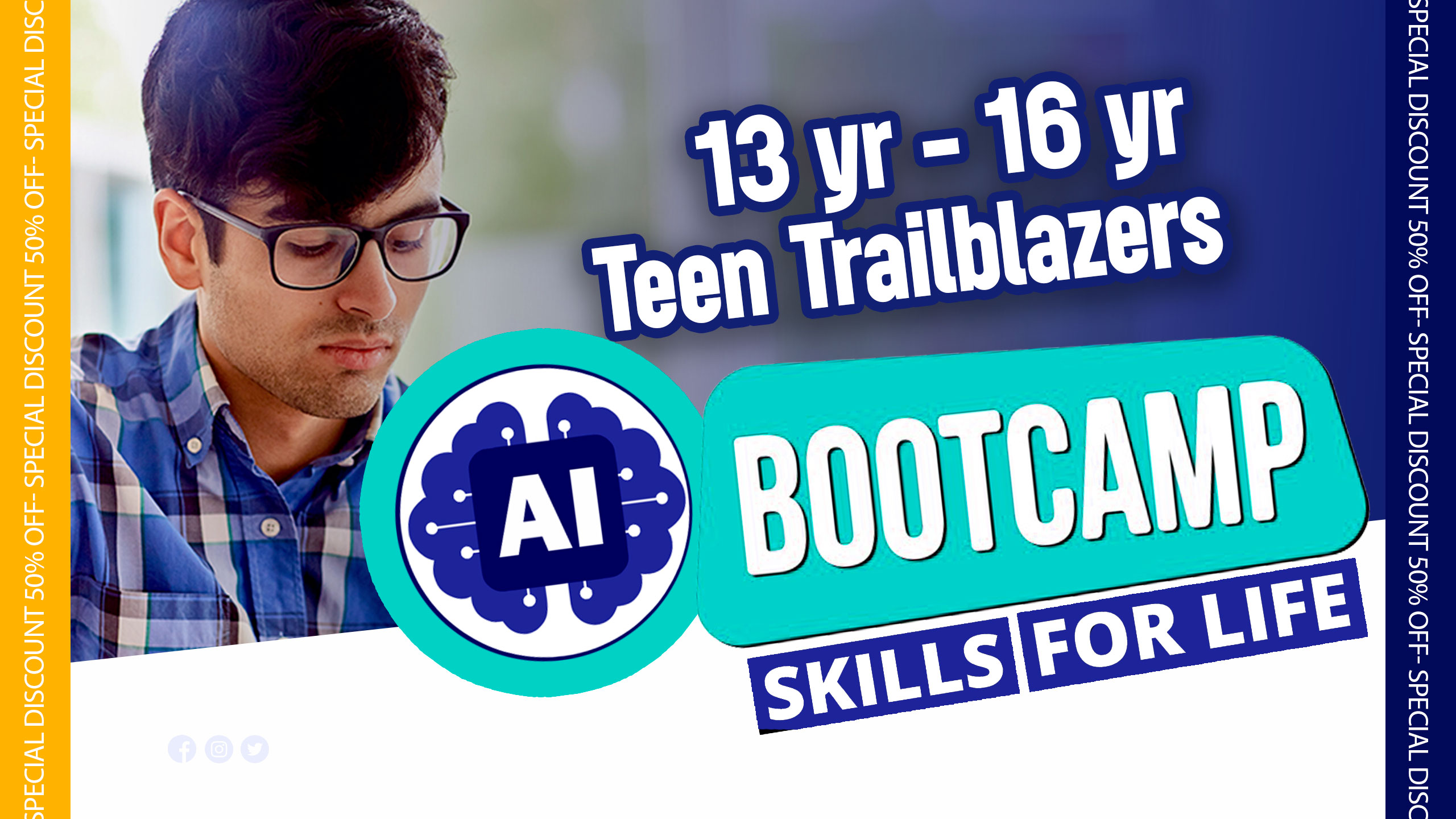
This course is designed for Kids aged between 13 years – 16 years that will empower them to create social media creatives, content creations, and understand how AI works Kids who will be out future, kids who would want to produce high-quality content faster, smarter, and more efficiently using AI.
Learning outcomes
- By enrolling your kid, they will learn how to use AI creatively in just one month:
- Understand what is AI and how it is useful in their student life and education.
- They will be more create and create attractive presentations, story boards and projects.
- Make them create their own music from AI tools to be used in their presentations.
- Make Presentations and walk through, present their ideas and study projects effectively.
- Simplify Studies with AI: Use AI to assist with homework, research, and productivity.
- Set Up a Google Account: Navigate Gmail, Drive, and more.
- Create Images: Generate stunning AI-powered visuals.
- Design Logos: Spark creativity by making logos and branding ideas.
- Write Stories & Essays: Use AI to brainstorm, draft, and polish creative writing.
Curriculum
- 24 Sections
- 190 Lessons
- 4 Weeks
- Chapter 1.1 Course Introduction5
- Chapter 1.2 AI Orientation and introduction22
- 2.1Lesson 1.2.1 What is AI, Implementations & AI Tools Overview
- 2.2Lesson 1.2.2 Three most Important Technologies of AI
- 2.3Lesson 1.2.3 Introduction to Machine learning (ML)
- 2.4Lesson 1.2.4 Introduction to Deep Learning
- 2.5Lesson 1.2.5 Introduction to Natural language processing (NLP)
- 2.6Lesson 1.2.6 Introduction to Data and Data Science
- 2.7Lesson 1.2.7 Introduction to Generative AI
- 2.8Lesson 1.2.8 Introduction to Prompt Engineering
- 2.9Lesson 1.2.9 Introduction to NotebookLM
- 2.10Lesson 1.2.10 Introduction to Copycat AI
- 2.11Lesson 1.2.11 Introduction to ChatGPT, Claude, Gemini, Co-pilot and Nano Banana
- 2.12Lesson 1.2.12 Introduction to Coding, Scratch & Game Creation
- 2.13Lesson 1.2.13 Introduction to, HTML, Python Programming
- 2.14Lesson 1.2.14 Introduction to Robotics
- 2.15Lesson 1.2.15 Introduction to Creative AI – Videos, Images, Music
- 2.16Lesson 1.2.16 Introduction for AI for Presentations, Studies, Stories & Essays
- 2.17Lesson 1.2.17 Introduction to Plagiarism, Copyrights and Original Content
- 2.18Lesson 1.2.18 Introduction for AI for Presentations, Studies, Stories & Essays
- 2.19Lesson 1.2.19 Introduction to Social Media Apps, Website & Server basics
- 2.20Lesson 1.2.20 Introduction on Capstone project and Professional Certificate
- 2.21Lesson 1.2.21 Introduction to Cybersecurity and Quantum Computing
- 2.22Lesson 1.2.22 Introduction to Professional Courses on Future Technologies
- Lesson 1.3 What is AI, Implementations & AI Tools Overview10
- 3.1Lesson 1.3.1 What is AI? How does AI work?
- 3.2Lesson 1.3.2 Why is Artificial Intelligence important?
- 3.3Lesson 1.3.3 Components of Artificial Intelligence (AI)
- 3.4Lesson 1.3.4 Top AI Tools for Kids & Students
- 3.5Lesson 1.3.5 Real-World AI Examples around you
- 3.6Lesson 1.3.6 Let’s be Friends with AI
- 3.7Lesson 1.3.7 Studying and Creating with your New Friend AI
- 3.8Lesson 1.3.8 Amaze your Family and Teachers with AI magic
- 3.9Lesson 1.3.9 Studying and Creating with your New Friend AI
- 3.10Lesson 1.3.10 Amaze your Family and Teachers with AI magic
- Chapter 1.4 Key Components of AI10
- 4.1Lesson 1.4.1 Learning
- 4.2Lesson 1.4.2 Reasoning
- 4.3Lesson 1.4.3 Problem-Solving
- 4.4Lesson 1.4.4 Perception
- 4.5Lesson 1.4.5 Language Understanding
- 4.6Lesson 1.4.6 Knowledge representation and Reasoning
- 4.7Lesson 1.4.7 Machine Learning (ML)
- 4.8Lesson 1.4.8 Deep Learning (DL)
- 4.9Lesson 1.4.9 Robotics
- 4.10Lesson 1.4.10 Generative Capability, Generative AI and agentic AI
- Chapter 1.5 Machine learning (ML)10
- 5.1Lesson 1.5.1 Introduction to AI & Machine Learning
- 5.2Lesson 1.5.2 Image Recognition/Classification
- 5.3Lesson 1.5.3 Speech & Sound Recognition
- 5.4Lesson 1.5.4 AI Games (Scratch)
- 5.5Lesson 1.5.5 Chatbots & Text Processing
- 5.6Lesson 1.5.6 Basic Concepts of Machine Learning
- 5.7Lesson 1.5.7 Supervised Learning: Learning with Examples
- 5.8Lesson 1.5.8 Unsupervised Learning: Learning on Its Own
- 5.9Lesson 1.5.9 Reinforcement Learning: Learning by Trial & Error
- 5.10Lesson 1.5.10 Real-World Applications of Machine Learning
- Chapter 1.6 Deep Learning10
- 6.1Lesson 1.6.1 Key Aspects of Deep Learning
- 6.2Lesson 1.6.2 Key Differences from Machine Learning
- 6.3Lesson 1.6.4 Deep Learning Models
- 6.4Lesson 1.6.5 Supervised Learning
- 6.5Lesson 1.6.3 Image recognition, NLP, Speech recognition
- 6.6Lesson 1.6.6 Reinforcement Learning
- 6.7Lesson 1.6.7 Frameworks Tensorflow, Keras, PyTorch
- 6.8Lesson 1.6.8 Inspired by the Brain
- 6.9Lesson 1.6.9 Why is Deep Learning Important?
- 6.10Lesson 1.6.10 Challenges and Ethical Considerations
- Chapter 1.7 Natural Language processing (NLP)10
- 7.1Lesson 1.7.1 Natural Language Processing (NLP)
- 7.2Lesson 1.7.2 Where and Why do we need NLP?
- 7.3Lesson 1.7.3 Examples and How NLP Works?
- 7.4Lesson 1.7.4 Human Language vs Computer Language
- 7.5Lesson 1.7.5 Difficulties by machine to understand human language
- 7.6Lesson 1.7.6 Need and stages of NLP
- 7.7Lesson 1.7.7 There are 2 types of chatbots
- 7.8Lesson 1.7.8 Text Normalisation, Bag of Words
- 7.9Lesson 1.7.9 Challenges of NLP
- 7.10Lesson 1.7.10 Advantages and Disadvantages
- Chapter 1.8 Data and Data Science10
- 8.1Lesson 1.8.1 what is data science?
- 8.2Lesson 1.8.2 Importance of data science for students?
- 8.3Lesson 1.8.3 What Skills Do Kids Need to Start Learning Data Science?
- 8.4Lesson 1.8.4 what is data and Types of data
- 8.5Lesson 1.8.5 Data science examples and Applications
- 8.6Lesson 1.8.6 Core data and mathematical skills
- 8.7Lesson 1.8.7 What is Big Data
- 8.8Lesson 1.8.8 Basics of Data Visualization.
- 8.9Lesson 1.8.9 Basics of Data Analytics
- 8.10Lesson 1.8.10 Will Learning Data Science Help in School Subjects?
- Chapter 1.9 Generative AI10
- 9.1Lesson 1.9.1 What is Generative AI? AI vs Humans
- 9.2Lesson 1.9.2 Prompt Engineering Introduction
- 9.3Lesson 1.9.3 Writing Poems and Stories using AI
- 9.4Lesson 1.9.4 Generating images using AI
- 9.5Lesson 1.9.5 Generating music using AI
- 9.6Lesson 1.9.6 How Generative AI Helps Children Learn Effectively
- 9.7Lesson 1.9.7 Benefits of using Generative AI
- 9.8Lesson 1.9.8 Applications of Generative AI in various Industries
- 9.9Lesson 1.9.9 Generative AI versus Traditional AI systems
- 9.10Lesson 1.9.10 How Learners Benefiting from Generative AI
- Chapter 1.10 Prompt Engineering10
- 10.1Lesson 1.10.1
- 10.2Lesson 1.10.2
- 10.3Lesson 1.10.3
- 10.4Lesson 1.10.4
- 10.5Lesson 1.10.5
- 10.6Lesson 1.10.6 Future Trends and Emerging Technologies
- 10.7Lesson 1.10.7 Generative Art, Video, and Voice AI
- 10.8Lesson 1.10.8 Domain-Specific Prompt Engineering
- 10.9Lesson 1.10.9 100 Prompts divided into 10 Categories
- 10.10Lesson 1.10.10 What real-world skills will you gain?
- Chapter 1.11 NotebookLM10
- 11.1Lesson 1.11.1
- 11.2Lesson 1.11.2
- 11.3Lesson 1.11.3
- 11.4Lesson 1.11.4
- 11.5Lesson 1.11.5
- 11.6Lesson 1.11.6 File Types to Upload
- 11.7Lesson 1.11.7 Structure of NotebookLM
- 11.8Lesson 1.11.8 NotebookLM for Exam Preparation & Academic Projects
- 11.9Lesson 1.11.9 NotebookLM Use Cases
- 11.10Lesson 1.11.10 NotebookLM working with Text
- Chapter 1.12 Copycat AI10
- Chapter 1.13 ChatGPT, Claude, Gemini, Copilot and Nano Banana10
- 13.1Lesson 1.14.1
- 13.2Lesson 1.14.2
- 13.3Lesson 1.14.3
- 13.4Lesson 1.14.4
- 13.5Lesson 1.14.5
- 13.6Lesson 1.13.6 B- Image Generation Nano Banana
- 13.7Lesson 1.13.7 Claude (Anthropic)
- 13.8Lesson 1.13.8 Claude in Excel & PowerPoint
- 13.9Lesson 1.13.9 Nano Banana 2/Pro (Google DeepMind)
- 13.10Lesson 1.13.10 Storybooks, educational posters, and colouring pages
- Chapter 1.14 Coding, Scratch & Game Creation10
- Chapter 1.15 HTML, Python Programming10
- Chapter 1.16 Robotics10
- Chapter 1.17 Creative AI - Videos, Images, Music9
- 17.1Lesson 1.18.1 Emerging Technologies of the Future
- 17.2Lesson 1.18.2 Current career trends Why AI is Required
- 17.3Lesson 1.18.3 Type of Industries and Career Growth
- 17.4Lesson 1.18.4 Indian Government Support and Initiatives
- 17.5Lesson 1.18.5 Get Free Certifications from Top Tech Companies
- 17.6Lesson 1.18.6 Insta AI Academy Introduction and Importance
- 17.7Lesson 1.17.8
- 17.8Lesson 1.17.9
- 17.9Lesson 1.17.10
- Chapter 1.18 AI for Presentations, Studies, Stories & Essays9
- Chapter 1.19 Plagiarism, Copyrights and Original Content5
- Chapter 1.20 AI for Presentations, Studies, Stories & Essays0
- Chapter 1.21 Social Media Apps, Website & Server basics0
- Chapter 1.22 Cybersecurity and Quantum Computing0
- Chapter 1.23 Capstone Project and Professional Certificate0
- Chapter 1.24 Professional Courses on Future Technologies0

